How to Lead Without Owning Everyone’s Feelings
The Leadership Trap No One Talks About
When multiple clients start independently circling the same question, I pay attention.
Lately, that question has been:
“Who owns those emotions?”
It keeps surfacing in conversations about hard feedback, tough decisions, and the weight leaders carry when they believe they’re responsible for how other adults feel.
Let me share an example. Client 1 had been wrestling with a tough conversation. He faced the challenge of delivering difficult feedback and making a decision he feared wouldn’t be well received by his teammate. His hesitation wasn’t due to uncertainty about his choice, but because he didn’t want to, essentially, hurt his teammate’s feelings.
So I offered him a little relational logic puzzle:
Let’s say your kid scribbles on the wall and you get angry. Who owns those emotions and reaction?
He smiled. “I do.”
Okay. Now flip it. You do something another adult doesn’t like and they get angry. Who owns that?
The pause that followed was telling. What felt straightforward suddenly became more nuanced: when my actions impact someone, who owns the resulting emotion?
This newsletter is about that pause.
We’ll unpack why so many thoughtful leaders assume responsibility for other adults’ feelings, how that belief shapes decisions, and a more effective way to think about relational responsibility. One that allows you to stay warm and caring with people while remaining strong on outcomes.
Because many leaders delay hard decisions not from a lack of courage, but from the belief that they are responsible for how others will feel.
Why Leaders Feel 10% Responsible for Other People’s Emotions
I’m lucky to work with healthcare leaders who are genuinely kind, values-driven humans. They want to give back. They care deeply about the people in front of them. (Did I mention how lucky I am?)
BUT that’s exactly where this gets tricky.
Compassion and empathy are strengths. But sometimes leaders confuse compassion with emotional ownership.
They care about how others feel. And without meaning to, they start taking responsibility for those feelings.
I’ve heard clients say they worry about being perceived as cold, mean, or uncaring. Or they don’t want to become the kind of leader they once struggled under.
So instead, they swing to the opposite pole. Over-functioning, over-carrying, and taking on more than is theirs.
Just yesterday, an executive coaching client shared how he was leading colleagues through a change he neither created nor agreed with. I asked him, “What percentage of responsibility do you have for how your reports react to this?”
He said, “Maybe 10%.”
It was such a truthful answer and probably what most of us would say if we were being honest.
But from a bird’s-eye view? He didn’t control the decision. He didn’t design the policy. He couldn’t dictate how others would interpret it.
So what exactly is this 10% he named?
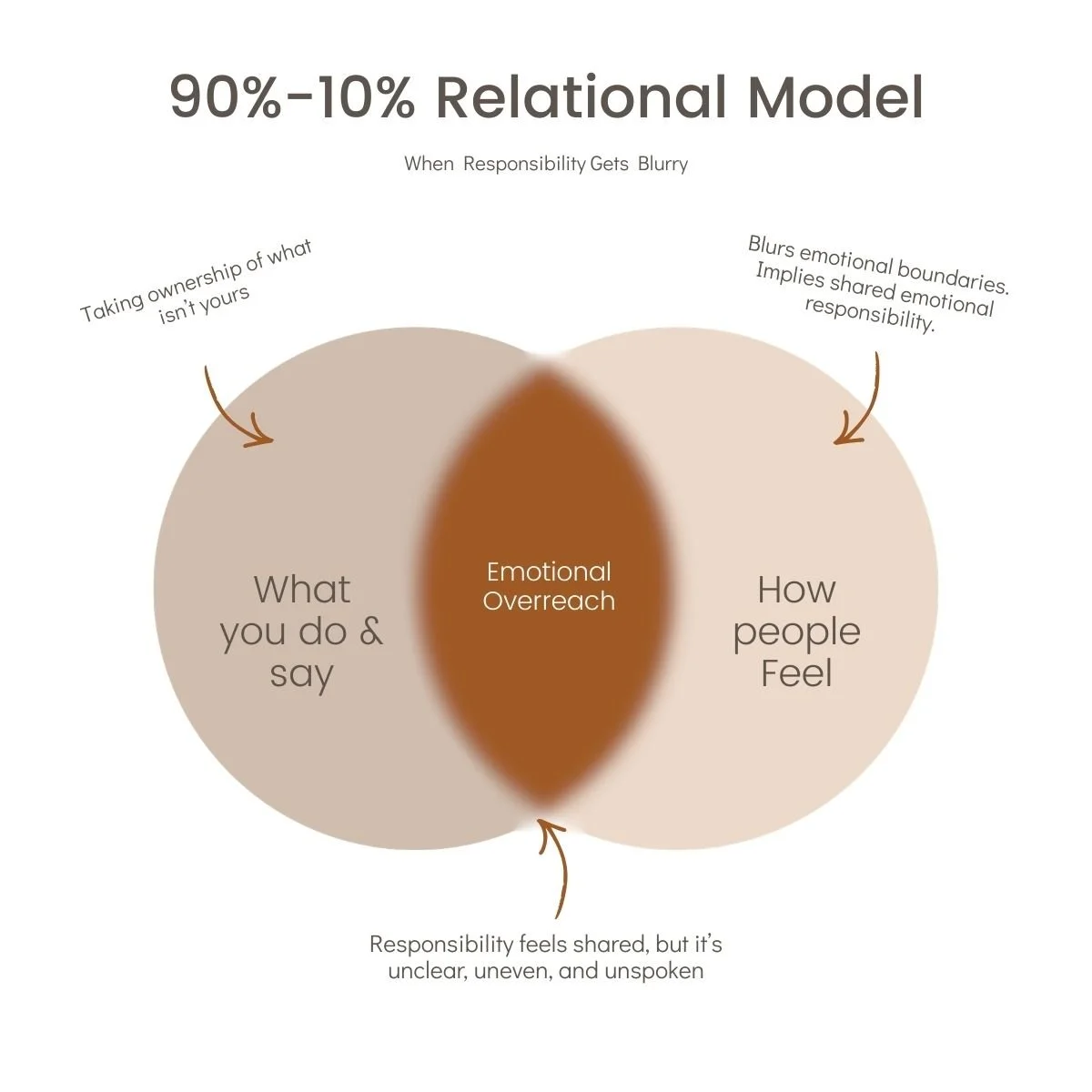
90% - 10% Relational Responsibility Model
He felt responsible for their reactions, as if his job was to absorb a shockwave he didn’t initiate.
And that’s where so many thoughtful leaders get tangled — they assume that caring about people means cushioning emotional impact. When in reality, it can turn into over-functioning for other adults.
So Who Owns the Emotions? The 100% + 100% Model.
Let’s turn this on you. Think about a time someone riled you up, or maybe they were short, dismissive, or unfair.
Who owns your emotions and reaction to the situation? If we’re honest, it’s YOU.
Did they act in integrity? Maybe not, that’s on them.
But your reaction? Your interpretation? Your anger and frustration? That’s yours.
We instinctively understand this when it comes to ourselves.
Now flip it — If they own their behavior and you own your reaction… what happens when you’re the one delivering the hard message?
You own:
Your clarity, integrity, and decision
Your tone and how the message is delivered
Your words and delivery
They own:
Their interpretation
Their emotional processing
Their reaction and next move
This is not a 90/10 split. It’s not 90% their behavior and 10% your emotional cushioning.
It’s 100% + 100%.
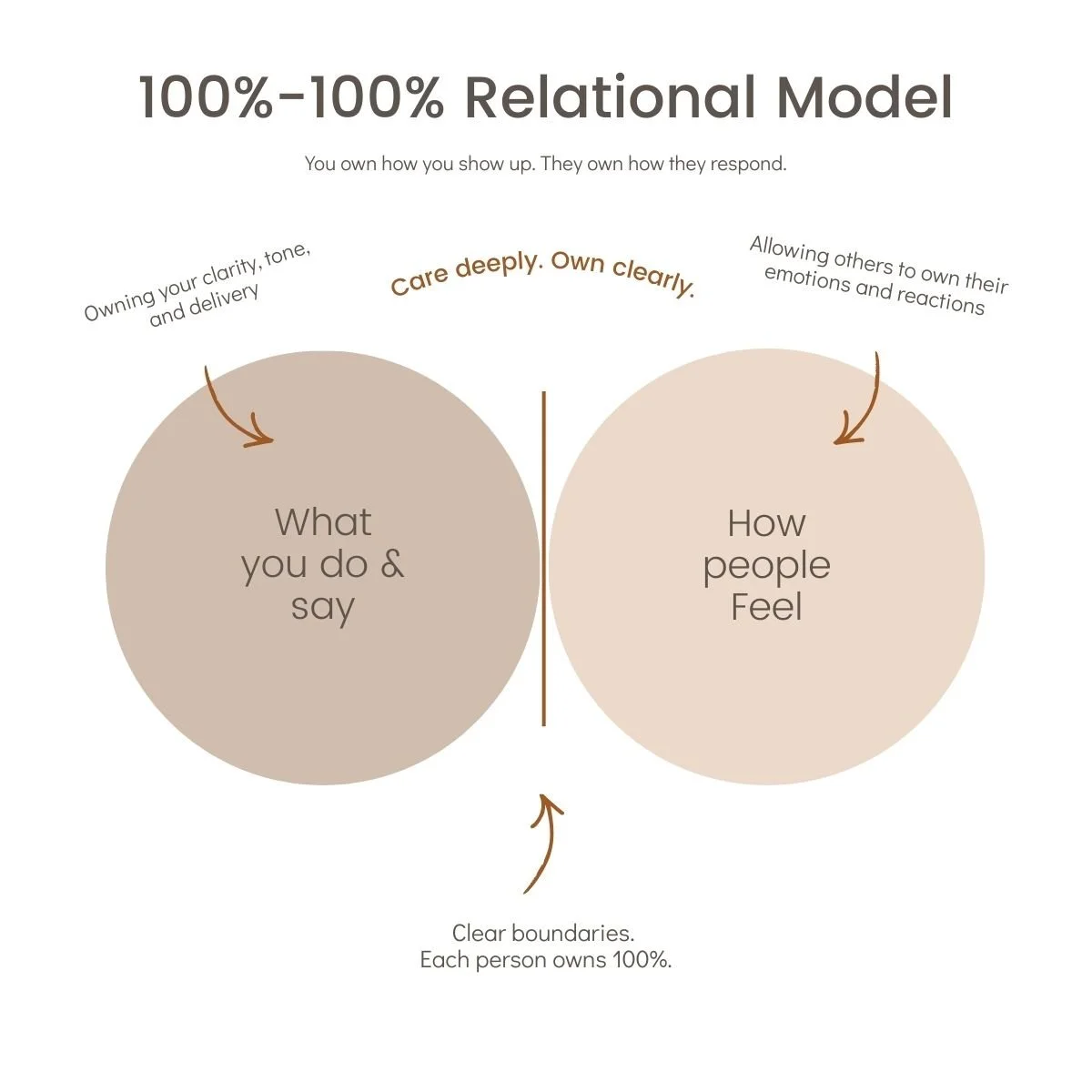
100% - 100% Relational Responsibility Model
You are 100% responsible for how you show up. They are 100% responsible for how they process it.
That’s the magic formula.
Anything less starts to blur lines and subtly suggests someone else cannot handle their own internal world… and that’s not compassion, it’s control dressed up as kindness.
You’re Allowed to Care, 1000%!
Let me say the silent part out loud: none of this is about being cold, detaching, or pretending not to care. In fact, the leaders I’m talking about care deeply. That’s the whole point!
It is so beautifully human to worry about how a message will land. It makes sense to want to protect someone from disappointment or discomfort. It’s generous to care about your relationship and about the impact your words may have, even if you’re just the messenger.
The shift I’m proposing isn’t about caring less, it’s about caring clearly.
You can hold a hard line and hold warmth at the same time.
You can say, “I care about you and our relationship,” and also say, “This decision stands.”
You can acknowledge, “It’s hard for me to share this,” while still delivering direct feedback.
You can affirm, “Your growth matters to me,” and still hold someone accountable.
When you express your care out loud, you are owning what is yours: your values, your intention, your investment in the relationship.
What you don’t have to own is how the other person processes the message.
Letting go of emotional ownership isn’t about disengagement. It’s about respecting the other person’s emotional adulthood. In coach-speak, we describe people as creative, resourceful, and whole. That means we trust their capacity to feel disappointment, frustration, even anger, and still navigate their way forward.
When we assume someone cannot handle discomfort, we unintentionally treat them as fragile. And that subtle shift has consequences.
Warmth and strength are not opposites. They can live in the same sentence.
Leadership Is 100% Ownership — Of Yourself
So we come back to that pause.
The moment after the question, “Who owns those emotions?” when you feel your brain trying to bargain — maybe it’s 10%. I’m the leader; it’s my job, maybe I can cushion it.
That pause is where the real work is.
It’s where you remember that caring doesn’t mean carrying. That leadership doesn’t require you to absorb every reaction in the room. You can say the hard thing and the caring thing in the same breath.
You can own your clarity. You can own your tone. You can own your intention. You can even own your care for the other.
And you can let other adults own their emotional experience.
The next time you hesitate before a difficult conversation, don’t ask, “How do I make sure this doesn’t upset them?” Ask instead, “How do I show up clearly AND caring?”
Then trust that they are capable of doing the rest.
Vanessa is an Executive and Leadership Coach and founder of V & CO Coaching, where she helps the overachieving and underfulfilled develop self-leadership skills so they can make their unique impact on the world. And to those who questioned the practicality of her art history degree — behold, the infographics.